
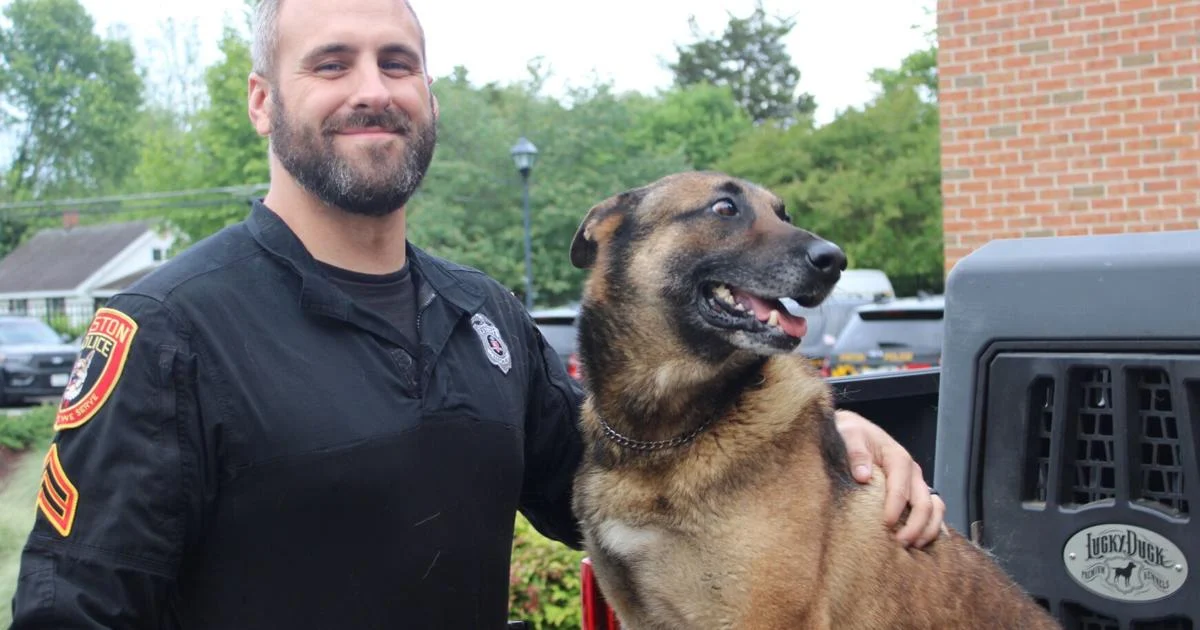
EASTON — K-9 Murph, a retired police dog from the Easton Police Department, has transitioned to retirement following the legalization of recreational cannabis in Maryland. This change in law has impacted the role of police dogs across the state, especially those trained to detect substances that are now legal.
Murph, who is now seven years old, spent several years working alongside Corporal Joseph Schinault. Schinault recalls the initial moment when Murph successfully tracked down a suspect, highlighting the dog’s efficiency and training. Since his retirement in 2024, Murph has taken on a different role, becoming a family companion to Schinault and his family.
The legalization of cannabis has prompted law enforcement agencies to reevaluate the training and assignments of K-9 units. Traditionally, these dogs were trained to detect illegal drugs, including cannabis. With the new legislation, their effectiveness in detecting cannabis is diminished, leading to a shift in their duties.
For Schinault, Murph’s retirement has been an adjustment. He describes the bond they share as strong, noting that Murph is now playing a vital role in his family life. The ex-police dog enjoys playing in the yard and spending time with Schinault’s young son, forming a close friendship that extends beyond their previous working relationship.
As the cannabis industry continues to evolve in Maryland, law enforcement agencies are considering how to adapt their K-9 programs. Some departments are exploring alternative training focused on other narcotics or expanding the role of K-9s to include search and rescue operations or community engagement.
Murph’s case reflects broader changes in law enforcement as society shifts its perceptions of cannabis use. The transition from active duty to retirement serves as a reminder of how legislation can directly influence not only the work of police officers but also the lives of their K-9 partners.


 English
  Spanish
  German
  Czech
Czech