
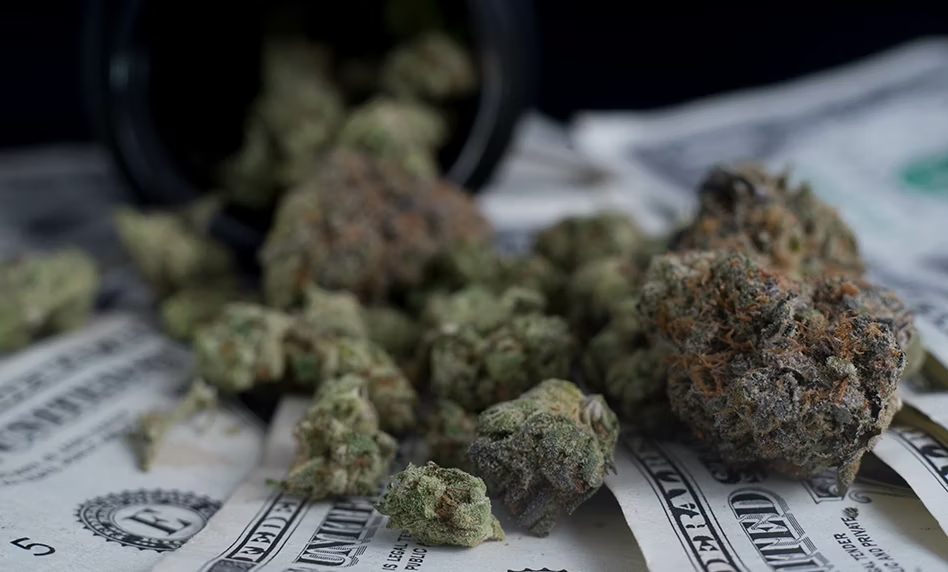
California’s Assembly Bill 564, aimed at stopping a planned increase in the cannabis excise tax, passed through the Assembly Revenue and Taxation Committee with a unanimous 6-0 vote on May 5. This legislation seeks to prevent the excise tax rate from rising from 15% to 19% starting July 1, 2025. The proposed increase, orchestrated by Governor Gavin Newsom in a budget trailer bill three years ago, represents a 26.7% hike in taxes on cannabis sales, which has raised concerns among industry participants.
Spearheaded by Assemblymember Matt Haney, a Democrat from San Francisco, the bill has gained significant support, having previously passed the Business and Professions Committee with a 15-0 vote on April 22. With more than a quarter of the Assembly’s members backing the bill, it now advances to the Appropriations Committee for further consideration.
Haney emphasized the adverse impact of the tax increase on the cannabis retail sector, stating, “This is a tax increase that is solely going to be on this single industry.” He highlighted the ongoing challenges faced by licensed cannabis businesses, particularly as illegal and untaxed cannabis operations continue to thrive. According to a report from ERA Economics, unlicensed cultivators in California produce an estimated 11.4 million pounds of cannabis annually, with about 2.4 million pounds consumed within the state and 9 million pounds exported.
This unregulated market constitutes approximately 63% of the cannabis consumed in California and 89% of the total cannabis produced, resulting in over $1 billion in lost excise tax revenue for the state. The California Department of Tax and Fee Administration (CDTFA) reported that licensed cannabis operators generated only $600,000 in excise tax revenue in 2024, falling short of the $670 million target set by the 2022 law designed to prevent the tax hike.
Industry advocates warn that increasing taxes will lead to a decline in licensed operators and a reduction in overall revenue. Haney pointed out, “More and more small cannabis businesses are succumbing to the pressure of overtaxation.”
Without the passage of A.B. 564 or similar legislation, the CDTFA announced on May 1 that it is mandated by the 2022 law to enforce the excise tax increase. Amy Jenkins, executive director of the California Cannabis Operators Association, which represents around 300 licensed businesses, testified in favor of the bill, stating, “It is in a crisis, and any suggestion that this crisis is overstated is a misrepresentation of the facts.”
The cannabis industry in California has already faced significant job losses, with 12,600 jobs disappearing in 2023 and another 5,000 in 2024, according to the employment agency Vangst. The excise tax revenues generated since the legalization of adult-use cannabis in 2018 have exceeded $3.7 billion, funding various state programs, including child care, youth initiatives, conservation efforts, law enforcement, and drug prevention services.
Opposition to the bill includes testimony from Alex Loomer of the Resources Legacy Fund, a nonprofit focused on environmental conservation. Loomer argued that the tax serves to protect children’s welfare and environmental initiatives, framing the debate as a choice between safeguarding public interests and increasing profits within the cannabis industry.
Despite Loomer’s claims, Jenkins noted the intention of Proposition 64, which legalized adult-use cannabis, stating that it contains multiple references to ensuring the legal market competes effectively against the illicit market. The current tax structure, however, appears to be having the opposite effect.
As the legislation moves forward, industry stakeholders remain hopeful that A.B. 564 will mitigate the impact of the impending tax increase, allowing licensed operators to stabilize and thrive in an increasingly competitive market.

 English
  Spanish
  German
  Czech
Czech