
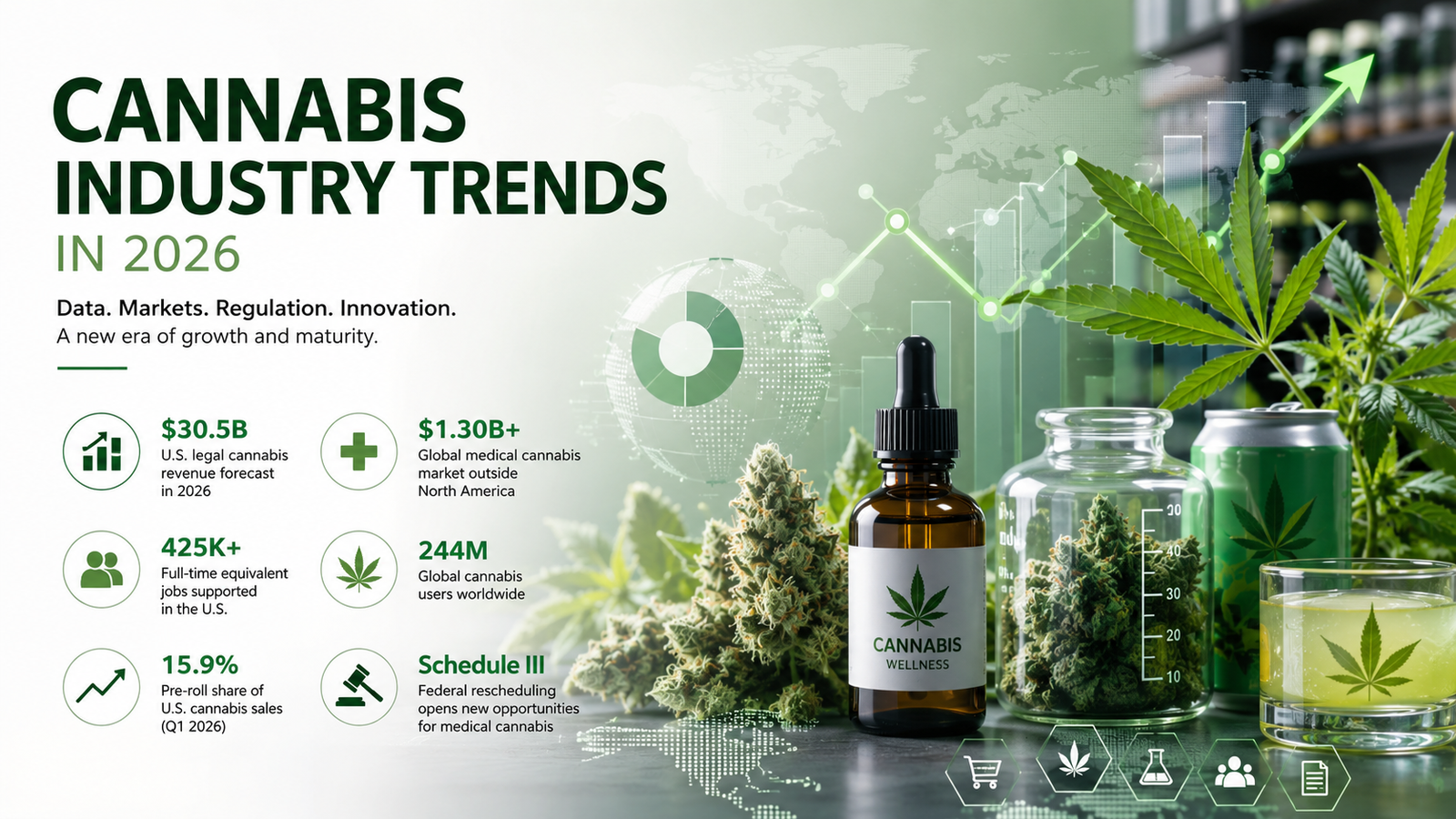
Introduction: Cannabis is no longer just a legalization story
The cannabis industry in 2026 is entering a more mature, more complicated and more data-driven phase. For years, the industry was mostly described through a single lens: legalization. Which state would legalize next? Which country would open a medical cannabis program? Which company would become the next cannabis giant?
That story is no longer enough.
In 2026, cannabis is becoming a global industry shaped by regulation, medical access, consumer products, capital markets, public health, technology, taxation and international trade. The industry is still growing, but not in the simple “green rush” way many investors imagined five or six years ago. Some markets are expanding quickly. Others are flat or declining. Some product categories are booming. Others are under heavy price pressure. Medical cannabis is becoming more international. Hemp-derived THC is facing a regulatory crackdown. THC beverages are moving into the territory once dominated by alcohol. Pre-rolls are becoming one of the most important product categories in North America. And companies are being forced to operate with much more discipline.
The most important shift in 2026 is this: cannabis is moving from hype to infrastructure.
The winning companies are no longer just the ones with a recognizable brand or a license in a hot state. They are the companies that can manage compliance, taxes, inventory, pricing, medical documentation, patient access, product safety and capital constraints. The cannabis industry is still young, but it is starting to behave like a real consumer, healthcare and agricultural sector.
Key 2026 cannabis industry numbers
| Metric | Latest figure | Why it matters |
|---|---|---|
| Forecast U.S. legal cannabis revenue in 2026 | $30.5B | Growth is returning, but slowly |
| Estimated U.S. cannabis sales in 2025 | $29B | 2025 marked the first year-over-year decline after more than a decade of growth |
| Cannabis companies expecting positive revenue growth in 2026 | 87% | Operators are more optimistic than in 2025 |
| Average company capitalization from founders | 60% | Cannabis remains underbanked and founder-funded |
| U.S. cannabis jobs supported by legal cannabis | 425,002 FTE jobs | The sector remains a major employer despite job contraction |
| Canadian medical cannabis exports in 2025 | 275,343 kg | Canada dominates global medical cannabis supply |
| Germany medical cannabis market size in 2025 | ~$997M | Germany is the largest medical cannabis market outside North America |
| Germany medical cannabis market growth | 155% YoY | Europe’s medical cannabis opportunity is accelerating |
| UK medical cannabis market size in 2025 | ~$298M | The UK is now Europe’s second-largest patient market |
| UK medical cannabis market growth | 104% YoY | Private clinics and telemedicine are driving growth |
| U.S. pre-roll share of cannabis sales in Q1 2026 | 15.9% | Pre-rolls are becoming a core retail category |
| Canada pre-roll share of cannabis sales in Q1 2026 | 32.4% | Pre-rolls have overtaken flower in Canada |
| New York cannabis sales in April 2026 | $145.8M | New York is becoming a top-five U.S. market |
| California cannabis sales in April 2026 | $311M | California is still the biggest U.S. market, but it is shrinking YoY |
| Global cannabis users | 244M | Cannabis remains the world’s most widely used drug |
1. The U.S. market is recovering, but the easy-growth era is over
The United States remains the most important cannabis market in the world, but 2026 makes one thing clear: the market is no longer growing automatically. Legal cannabis revenue in the U.S. is forecast to reach about $30.5 billion in 2026, up 4.9% from 2025. That sounds positive, and it is, but the context matters. The previous year was the first time the regulated U.S. cannabis market experienced a year-over-year revenue decline.
That decline was not caused by falling consumer interest. In many markets, unit volumes remained healthy. The real problem was price compression. In plain English: consumers were still buying cannabis, but they were paying less for it. Oversupply, discounting, intense competition, tax pressure and too many similar products pushed prices down.
This is one of the most important market realities of 2026. Cannabis demand is real, but demand alone does not guarantee profitability.
In mature states such as California, Colorado, Oregon and Michigan, the legal market is no longer a novelty. Consumers are experienced. Retailers compete aggressively. Brands fight for shelf space. Flower prices have fallen. Margins are thinner. Operators cannot rely on early legalization excitement anymore.
California shows the maturity problem clearly. It remains the largest legal cannabis market in the United States, with April 2026 sales of about $311 million and more than 17.3 million units sold. But sales were down 7.1% year over year, and average item prices fell from $18.89 in April 2025 to $17.91 in April 2026. That means the biggest market is still huge, but it is not automatically growing.
By contrast, newer markets are still expanding rapidly. New York reached $145.8 million in cannabis sales in April 2026, up 15.8% year over year. Ohio has become one of the strongest growth stories in the Midwest, with sales rising 35% over the last 12 months to about $1.12 billion.
The lesson is simple: in 2026, the U.S. cannabis market is not one market. It is a patchwork of mature, declining, recovering and fast-growing state markets.
2. Federal rescheduling changes the medical market, but not everything
One of the biggest 2026 regulatory stories in the United States is federal rescheduling. In April 2026, federal authorities moved FDA-approved cannabis products and state-licensed medical marijuana into Schedule III. This is a major symbolic and financial shift, but it is not full legalization.
The distinction matters.
Schedule I is the most restrictive category under the Controlled Substances Act. For decades, cannabis businesses operating legally under state law still faced federal restrictions because cannabis remained federally illegal. One of the biggest business problems was Section 280E of the tax code, which prevents businesses trafficking in Schedule I or II substances from deducting ordinary business expenses. For cannabis operators, that created extremely high effective tax rates.
Moving state-licensed medical cannabis into Schedule III could reduce that burden for qualifying medical operators. It may also help research, medical investment and the legitimacy of state medical programs.
But recreational cannabis remains much more complicated. The rescheduling action does not create national adult-use legalization. It does not automatically allow interstate cannabis commerce. It does not mean dispensaries can operate like liquor stores. It does not fully solve banking. And it does not remove the need for licenses, tracking, recordkeeping and compliance.
This creates a two-track U.S. industry in 2026:
| Segment | Regulatory position in 2026 | Business implication |
|---|---|---|
| State-licensed medical cannabis | Benefits from Schedule III treatment | Better tax and research outlook |
| FDA-approved cannabis medicines | Schedule III treatment | More pharma-like pathway |
| Adult-use recreational cannabis | Still federally constrained | Banking, tax and interstate issues remain |
| Hemp-derived intoxicating THC | Facing new federal restrictions | Many products may be forced out or into licensed cannabis channels |
The practical result is that medical cannabis businesses may become more attractive to investors than purely recreational operators. The industry is not becoming less regulated. It is becoming more segmented.
3. Medical cannabis is becoming a global supply chain
Outside the United States, the biggest cannabis story is the rise of international medical cannabis. The market is no longer just about local dispensaries or domestic legalization. It is increasingly about cross-border supply chains, pharmaceutical standards and patient access.
Canada is the clearest example. In 2025, Canadian companies exported 275,343 kg of medical cannabis, more than all other exporting countries combined. That was more than 250% growth year over year. Canada’s advantage is scale. It has a mature domestic adult-use market, large licensed producers, established cultivation infrastructure and experience with regulated cannabis production.
Germany is the demand-side story. Germany’s medical cannabis market grew 155% year over year to roughly $997 million in 2025, making it the largest medical cannabis patient market outside North America. The UK also more than doubled, reaching about $298 million, with growth of 104% year over year.
This changes the geography of cannabis. The industry is no longer centered only on North American adult-use markets. Europe is becoming a medical cannabis growth engine, but in a very different way from the United States.
European cannabis is more medical, more prescription-driven and more compliance-heavy. Companies need EU-GMP standards, consistent supply, documentation, product stability and relationships with doctors, pharmacies and telemedicine clinics. This favors serious operators over casual growers.
4. Telemedicine is becoming the access layer for medical cannabis
One of the most important medical cannabis trends in 2026 is telemedicine. In several markets, especially Germany, the UK, Australia and Brazil, cannabis-focused teleclinics are becoming the main way patients access medical cannabis.
This matters because telemedicine changes the business model.
In a traditional medical system, access depends on doctors, hospitals and pharmacies. In the cannabis telemedicine model, specialized clinics educate patients, assess eligibility, issue prescriptions and often influence which products patients use. That makes teleclinics powerful commercial gatekeepers.
Germany has 35 identified medical cannabis teleclinics. The UK has 29. These numbers matter because they show that patient access is not just expanding through traditional healthcare. It is expanding through digital-first medical infrastructure.
But this also creates risks. If telemedicine becomes too transactional, regulators may intervene. In the UK, the growth of private cannabis clinics has already raised concerns about prescribing standards, mental health screening and whether complex patients should be assessed only by video. In Germany, rapid growth in prescriptions and imports has created political pressure to review online access and mail-order models.
The future of medical cannabis telemedicine will depend on trust. Clinics that can prove responsible screening, proper follow-up and strong clinical governance will likely survive. Clinics that look like prescription mills may become regulatory targets.
5. Europe is not becoming “the next California”
It is tempting to describe Europe as the next major recreational cannabis market. That is partly true, but misleading. Europe is not following the same path as California, Colorado or Canada.
In 2026, Europe’s cannabis opportunity is mostly medical, semi-medical or experimental. Germany has partial adult-use legalization, but not a full commercial dispensary model like many U.S. states. Adults can possess certain amounts, grow limited plants at home and participate in cannabis clubs, but broad commercial adult-use retail remains restricted.
The Czech Republic is moving toward a regulated adult-use model, and Switzerland continues pilot programs that test regulated cannabis sales in specific cities. These are important developments, but they are controlled experiments rather than free-market rollouts.
Europe’s cannabis future is likely to be slower, more regulated and more medicalized than the North American model. This may frustrate consumer brands, but it creates opportunities for companies that understand healthcare, compliance and supply chains.
The biggest European cannabis winners in 2026 are likely to be:
- Medical importers with strong regulatory documentation.
- EU-GMP producers and processors.
- Telemedicine platforms with proper clinical governance.
- Pharmacies and distribution partners.
- Data and compliance software providers.
- Brands that can work within medical restrictions rather than mass-market advertising.
6. THC beverages are moving cannabis into alcohol’s territory
THC beverages are one of the most culturally important trends in 2026. They are not the biggest cannabis category by sales, but they are strategically important because they place cannabis in a social drinking context.
For many consumers, THC drinks are not simply “another edible.” They are an alternative to beer, wine or cocktails. They are designed for relaxation, socializing, light intoxication and controlled dosing. This makes them attractive to younger consumers who are rethinking alcohol.
A 2026 NIQ-linked survey found that 27% of Gen Z and 26% of Millennials reported consuming THC beverages in bars or restaurants in the previous six months. By comparison, only 9% of Gen X and 2% of Boomers said the same.
That generational gap matters. Cannabis beverages are not just a product trend; they are part of a broader shift in how younger adults think about intoxication, wellness and social rituals.
The strongest positioning for THC beverages is low-dose and sessionable. Many consumers do not want a strong edible experience that lasts for hours. They want a light, controllable effect. That is why drinks with 2 mg, 5 mg or 10 mg of THC have become a meaningful category.
But THC beverages also face a major regulatory challenge. Many of the most widely distributed THC drinks in the U.S. are hemp-derived, not marijuana-derived. That has allowed them to enter mainstream retail channels in some states. However, new federal hemp restrictions set to take effect in late 2026 could remove many intoxicating hemp products from the market unless Congress or regulators create a new framework.
In short: THC beverages have product-market fit, but their legal foundation is unstable.
7. Hemp-derived THC is moving from loophole to crackdown
The hemp-derived THC market exploded because of a legal gap created by the 2018 Farm Bill. Hemp was defined around delta-9 THC concentration by dry weight, which allowed companies to sell products containing delta-8 THC, THCA, hemp-derived delta-9 THC and other intoxicating cannabinoids.
This created a huge gray market. Consumers could buy intoxicating THC products outside licensed cannabis dispensaries. Some products were sold in convenience stores, smoke shops, online stores and even mainstream beverage channels. For consumers, it meant easier access. For regulators, it meant safety concerns. For licensed cannabis operators, it meant unfair competition.
In 2026, this gray area is closing.
New federal rules shift the focus toward “total THC” and impose a very low cap of 0.4 mg THC per container for finished hemp-derived consumer products. The rules also target chemically converted or synthetic cannabinoids. This is a major change because many current THC beverages, gummies and full-spectrum hemp products contain more than 0.4 mg THC per package.
The likely outcome is that the intoxicating hemp market will split into three groups:
| Product type | Likely 2026 direction |
|---|---|
| Non-intoxicating CBD/hemp products | May survive if compliant with stricter THC limits |
| Hemp-derived THC drinks/gummies | At risk under federal rules |
| Chemically converted cannabinoids | Most exposed to bans or enforcement |
| Licensed dispensary cannabis products | May benefit if hemp competitors disappear |
| State-regulated hemp markets | May try to preserve local frameworks, but interstate sales become harder |
This is one of the most important regulatory battles of 2026. The industry does not agree on the answer. Some want intoxicating hemp regulated like alcohol. Others want it pushed into licensed cannabis channels. Public-health groups want stronger testing and age restrictions. Licensed cannabis operators want a level playing field.
8. Pre-rolls are no longer a side category
For years, loose flower was the symbol of cannabis retail. That is changing.
Pre-rolls have become one of the most important cannabis categories in North America. In the U.S., pre-rolls reached 15.9% of total cannabis sales in Q1 2026, up 9.8% year over year. In Canada, pre-rolls are even more dominant: they reached 32.4% of sales and overtook flower in mid-2025.
Pre-rolls work because they solve a consumer problem. They are convenient, familiar and easy to buy. Consumers do not need grinders, papers, rolling skills or accessories. They can buy a single unit, a multipack, an infused product or a premium format.
The category is also becoming more sophisticated. Infused and connoisseur formats now account for 48.5% of U.S. pre-roll sales. Multipacks represent 54.2% of U.S. pre-roll sales and are growing faster than singles. In Canada, multipacks are nearly the default format, representing 86.3% of pre-roll sales.
This shows that cannabis consumers are moving toward packaged convenience. The shift is similar to what happened in other consumer categories: loose, commodity-like products give way to branded, packaged, repeatable formats.
9. Gummies and precise-dose edibles remain strong
Edibles continue to matter because they attract consumers who do not want to smoke or vape. Within edibles, gummies remain the dominant format because they are simple, flavorful, discreet and easy to dose.
The key consumer need is predictability. A gummy with 2.5 mg, 5 mg or 10 mg THC is easier for a new consumer to understand than a flower strain with a long terpene profile. The user may not understand all the chemistry, but they understand the serving size.
This is especially important for casual or wellness-oriented consumers. Many people entering the category in 2026 are not looking for the strongest product. They are looking for sleep support, stress relief, relaxation, pain management or an alcohol alternative.
That is why “low-dose” is one of the most important product concepts in 2026. Low-dose cannabis products reduce the fear of overconsumption and make cannabis easier to integrate into everyday life. They also fit with a broader consumer movement toward moderation.
However, edibles carry a safety challenge. Effects take longer to appear than inhaled cannabis. This increases the risk that inexperienced users consume more than intended. Responsible packaging, clear labeling and consumer education are therefore essential.
10. Price compression is forcing operational discipline
One of the strongest business trends in 2026 is margin pressure. The cannabis industry is full of demand, but many operators still struggle to make money.
The reason is simple: costs are high and prices are falling.
Legal cannabis businesses often face heavy taxes, licensing costs, compliance costs, security costs, testing costs and limited access to normal banking. At the same time, consumers in mature markets expect discounts. Retailers push brands for promotions. Producers compete on wholesale price. Illicit sellers often operate without the same tax and compliance burden.
This is why 2026 is a year of operational discipline. Companies need to manage inventory better, reduce waste, improve cultivation efficiency, optimize SKU counts and avoid overproduction. The old strategy of “grow fast and wait for legalization” is not enough.
The labor market reflects this shift. The U.S. legal cannabis industry supports about 425,002 full-time equivalent jobs, but employment declined 3.4% even as sales grew in the latest reported period. That means companies are not hiring blindly. They are becoming more selective, flexible and cost-conscious.
11. Debt is replacing equity as the main source of capital
The cannabis capital market has changed dramatically. During the hype years, many companies raised equity on the promise of legalization and national expansion. In 2026, investors are more skeptical. Profitability matters. Cash flow matters. Debt schedules matter.
Debt financing has become the dominant form of capital. According to Viridian Cannabis Deal Tracker data cited by MJBizDaily, debt accounted for about 94.8% of all capital raised by U.S. licensed operators in 2025. Much of this debt is not being used for aggressive expansion. It is being used to refinance existing loans.
This is important because it changes the power structure of the industry. Lenders, not equity investors, increasingly shape what cannabis companies can do. Companies with strong balance sheets can survive, refinance and acquire distressed assets. Companies with weak margins may be forced to sell, merge or shut down.
First Citizens’ 2026 report also shows that founders provide 60% of average cannabis company capitalization. That means many operators are still funding growth with their own money because traditional capital markets remain constrained.
The finance trend of 2026 is clear: cannabis is no longer a “growth at any cost” sector. It is becoming a survival, consolidation and cash-flow sector.
12. Illegal markets remain the hardest competitor to beat
Legalization does not automatically destroy the illegal market. This is one of the biggest lessons of the last decade.
If legal cannabis is too expensive, too hard to access or too limited in product selection, consumers continue buying from unlicensed sellers. This is especially true in states with high taxes, slow licensing or limited retail density.
New York is the clearest example. The legal market is growing quickly, but illegal sellers remain a major challenge. Legal sales reached $145.8 million in April 2026, making New York a top-five U.S. market, but premium pricing and the long presence of illicit stores continue to shape consumer behavior.
The same problem appears in other markets. If the price gap between legal and illegal products is too large, enforcement alone will not solve the problem. Regulators need enough licensed stores, reasonable tax structures, reliable supply, competitive pricing and consumer trust.
The real competition is not just between legal brands. It is between regulated and unregulated systems.
13. Technology is becoming the operating system of legal cannabis
Cannabis is one of the most compliance-heavy consumer industries in the world. Every gram can require tracking. Every batch can require testing. Every package may need labeling, potency data, QR codes and inventory records. Every sale may need to comply with state-specific purchase limits.
That is why technology is no longer optional.
The core cannabis tech stack in 2026 includes:
- Seed-to-sale tracking.
- Retail POS systems.
- Inventory management.
- Compliance reporting.
- Customer loyalty tools.
- Menu and e-commerce systems.
- Lab testing records.
- Payments and cash management.
- Demand forecasting.
- Delivery management.
- Data analytics for pricing and assortment.
AI will play a role, but not necessarily in the flashy way people imagine. The most valuable AI use cases are practical: demand forecasting, inventory optimization, SKU rationalization, customer segmentation, budtender support, fraud detection and compliance alerts.
In mature markets, technology becomes a margin tool. In new markets, it becomes a compliance tool. In medical markets, it becomes a patient-access and documentation tool.
14. Public health is becoming more central to the cannabis debate
As cannabis becomes more mainstream, public-health questions become harder to ignore. In 2026, the debate is no longer simply “legalize or prohibit.” The better question is: how should cannabis be regulated to reduce harm while allowing adults and patients legal access?
The CDC estimates that approximately 3 in 10 people who use cannabis have cannabis use disorder. Risk is higher among people who start young or use frequently. THC potency has also increased over time, and high-potency concentrates can create stronger effects and greater overconsumption risk.
This does not mean cannabis should be treated like heroin. It means the legal industry must take responsible use seriously.
The strongest public-health priorities in 2026 are:
- Age-gating and preventing youth access.
- Clear potency labeling.
- Safer edible packaging.
- Education around delayed onset.
- Warnings for high-THC products.
- Better screening in medical cannabis clinics.
- Impaired-driving research and enforcement.
- More data on cannabis use disorder.
- Stronger testing for contaminants and synthetic cannabinoids.
The future of cannabis depends on trust. If the industry ignores health risks, regulators will step in more aggressively. If the industry builds responsible-use standards, it will have a stronger long-term position.
15. Public support remains high, but more nuanced
Public opinion still favors cannabis reform, but support is becoming more nuanced. A January 2026 Pew Research Center survey found that 55% of U.S. adults believe marijuana should be legal for both medical and recreational use, while another 33% support medical-only legalization. Only 11% say it should not be legal at all.
That means 88% of Americans support some form of legal cannabis.
But “support legalization” does not mean “support every cannabis business model.” Voters may support medical cannabis but worry about youth use. They may support adult-use legalization but oppose unregulated hemp products in gas stations. They may support social equity but dislike illegal dispensaries. They may support patient access but want stronger clinic oversight.
This is the political reality of 2026: cannabis is broadly accepted, but not politically risk-free.
Final conclusion: the 2026 cannabis industry is bigger, tougher and more professional
The cannabis industry in 2026 is not collapsing, and it is not exploding. It is maturing.
The strongest markets are becoming more data-driven. The weakest operators are being exposed by debt, taxes and price compression. Medical cannabis is globalizing. Europe is growing, but through medical and regulated channels rather than a California-style retail boom. THC beverages are creating a new bridge between cannabis and alcohol occasions. Pre-rolls are proving that convenience can reshape category leadership. Hemp-derived THC is facing a major legal reset. Technology is becoming essential. Public health is becoming central. And capital is becoming more disciplined.
The headline trend is simple:
Cannabis is moving from legalization hype to regulated industry infrastructure.
For consumers, that should mean more predictable products, better labeling and safer legal access. For patients, it may mean broader medical availability and better telemedicine pathways. For businesses, it means higher standards and less room for amateur operations. For investors, it means cannabis can still be a growth market, but only for companies that understand regulation, margins, compliance and execution.
The future of cannabis in 2026 is not just about who can sell the most. It is about who can survive the transition from a movement into an industry.
Source map for the article
- U.S. market size and growth: Whitney Economics forecasts $30.5B in 2026 legal U.S. cannabis revenues, up 4.9% from 2025, while noting the market’s first year-over-year decline in 2025 and the role of price compression. (Whitney Economics)
- Operator confidence and capital structure: First Citizens reports $29B in estimated U.S. cannabis sales in 2025, 87% of surveyed cannabis companies expecting positive revenue growth in 2026, and founders providing 60% of average capitalization. (firstcitizens.com)
- Global medical cannabis: Prohibition Partners reports Canada exported 275,343 kg of medical cannabis in 2025, Germany grew 155% to about $997M, and the UK grew 104% to about $298M. (Prohibition Partners)
- Pre-roll category: Headset reports U.S. pre-rolls reached 15.9% of total cannabis sales in Q1 2026, while Canada pre-rolls reached 32.4% and became the largest category. (headset.io) MJBizDaily also reports pre-rolls generated $3.6B in sales and more than 383M units, with 15.9% market share. (MJBizDaily)
- State market dynamics: Headset reports California April 2026 cannabis sales of $311M, down 7.1% YoY, and New York April 2026 sales of $145.8M, up 15.8% YoY. (headset.io) Ohio sales grew 35% over 12 months to $1.12B, with flower at $558M, vapes at $291M, edibles at $139M, and drinks up 44% to $7M. (Shanken News Daily)
- Federal rescheduling and state medical cannabis: The Federal Register final rule places FDA-approved cannabis products and state-licensed medical marijuana in Schedule III and notes that 40 U.S. states have legalized medical marijuana systems. (Federal Register) NCSL reports 24 states, two territories and D.C. have legalized small amounts of cannabis for adult recreational use. (ncsl.org)
- Hemp-derived THC restrictions: The Brewers Association summary of the federal landscape states that the new rules shift to total THC, impose a 0.4 mg THC per container cap for finished hemp products and exclude synthetic/chemically converted cannabinoids. (Brewers Association)
- Consumer demand and THC beverages: NIQ-linked data reported by FoodNavigator shows 27% of Gen Z and 26% of Millennials consumed THC beverages on-premise in the previous six months, versus 9% of Gen X and 2% of Boomers. (FoodNavigator-USA.com)
- Jobs and workforce: The Vangst/Whitney Economics jobs report, summarized by Cannabis Business Times, reports 425,002 FTE jobs, down 3.4%, while 2024 retail sales reached $30.1B. (Cannabis Business Times)
- Capital markets: MJBizDaily reports debt financing accounted for about 94.8% of capital raised by U.S. licensed cannabis operators in 2025, with much of it used for refinancing rather than new growth. (MJBizDaily)
- Public opinion: Pew’s January 2026 survey found 55% of U.S. adults support medical and recreational legalization, 33% support medical-only legalization, and 11% say marijuana should not be legal. (Pew Research Center)
- Global cannabis use and health risk: UNODC reports 244M cannabis users globally, making it the world’s most widely used drug. (unis.unvienna.org) CDC estimates approximately 3 in 10 people who use cannabis have cannabis use disorder and notes higher risk among youth starters and frequent users. (cdc.gov)