
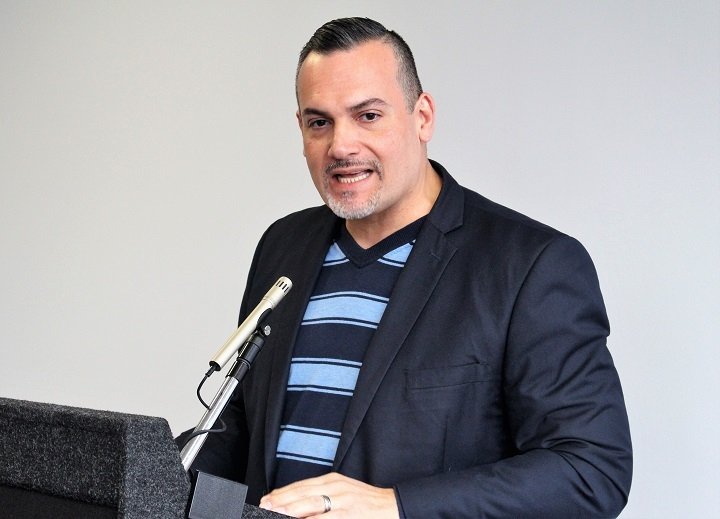
cannabis regulation is at the center of a debate over conflicts of interest after New Haven State Rep. Juan Candelaria voted on bills affecting the industry while working for a Hartford micro-cultivator.
Candelaria, who represents the 95th General Assembly District (parts of Fair Haven and the Hill), co-sponsored Connecticut’s 2021 bill that legalized adult-use recreational cannabis. In 2025 he took a job as director of operations and sales at The Goods THC Co., a cannabis cultivation company in Hartford. His 2025 Statement of Financial Interests lists The Goods as an income source, and the state’s license database records him as a “key cannabis employee” beginning September 2025.
During the most recent legislative session he voted on two cannabis-related bills: one that overhauled Connecticut’s taxation of cannabis and another that would have redefined industry terms (the tax bill passed; the redefinition measure failed). Before voting, Candelaria said he consulted the House Democrats’ staff attorney and confirmed the votes complied with state ethics rules.
On June 12 a Reddit post called attention to his employment and argued he should have recused himself. The post’s author, activist Louis Rinaldi, said Candelaria failed to disclose the relationship and that votes on industry-wide bills can create direct financial gain for employees of regulated businesses. Rinaldi said he supports reforms to limit corporate control and to improve the state’s social equity licensing process but still believes recusal was appropriate in this case.
Candelaria counters that he disclosed his job to the Office of State Ethics and that his role does not create a statutorily disqualifying conflict. “I earn a flat salary,” he told the Independent, adding that his primary duty is speaking with retail stores about products. He also resigned from the General Law Committee, which monitors cannabis rules, to reduce the appearance of a conflict.
Rep. Roland Lemar, co-chair of the General Law Committee, defended Candelaria’s votes. Lemar noted Candelaria has led legalization efforts in the state since before he worked for The Goods and argued lawmakers often draw on professional experience when drafting policy. “The test is whether you’re voting on anything that enriches yourself, your colleagues, or your business,” Lemar said, asserting none of those conditions applied.
Peter Lewandowski, executive director of the Office of State Ethics, said Connecticut’s part-time legislature means most members hold outside jobs. Current statute permits legislators to vote on industry-wide bills so long as their employers do not receive special treatment. Under existing rules, employees (but not owners) may vote on measures that disproportionately benefit their employers. The Office of State Ethics is pursuing changes to close that exception: the Senate passed a bill to expand the definition of conflict of interest to include actions that cause direct monetary gain or loss to a legislator’s non-state employer, but the measure has not passed the House.
The dispute intersects with a separate, policy-focused debate about social equity licensing. Connecticut’s licensing program aims to give licenses to people from communities disproportionately harmed by drug enforcement. Candelaria and others have argued that many social equity licensees lack startup capital and partner with large investors; some then sign away control, undermining the program’s intent.
Public Act 26-8, passed in May, addresses part of that problem by banning social equity applicants from transferring ownership of their licensed cannabis businesses to another entity. Applicants may use third-party consultants for support but must retain “final decision-making authority.” That provision takes effect in November.
Rinaldi praised Candelaria’s advocacy for social equity but said the employment raises a separate governance issue. “All elected representatives are expected to recuse themselves on matters that would have a direct, material impact on their financial gain,” he said. Candelaria maintains the measures he voted on affected the entire industry and did not deliver special treatment to his employer.
Facts in this case: Candelaria co-sponsored legalization in 2021; he began employment at The Goods in 2025 and recorded that income in a 2025 financial statement; he resigned from the General Law Committee after taking the job; the tax overhaul passed this session while a redefinition bill failed; and Public Act 26-8 includes a November effective date for its anti-transfer provision.
The episode highlights two measurable tensions in Connecticut’s cannabis policy: (1) balancing legislators’ outside employment with the need to prevent decisions that produce direct financial gain, and (2) enforcing social equity goals while limiting large investors from acquiring control of equity licensees. The legislature has introduced statutory changes to narrow conflicts-of-interest allowances, but those reforms remain pending in the House.
For now, Candelaria remains in his House seat and at The Goods. He says he will continue to back measures that protect social equity applicants and to vote on industry-wide legislation after consulting legal counsel when necessary.