
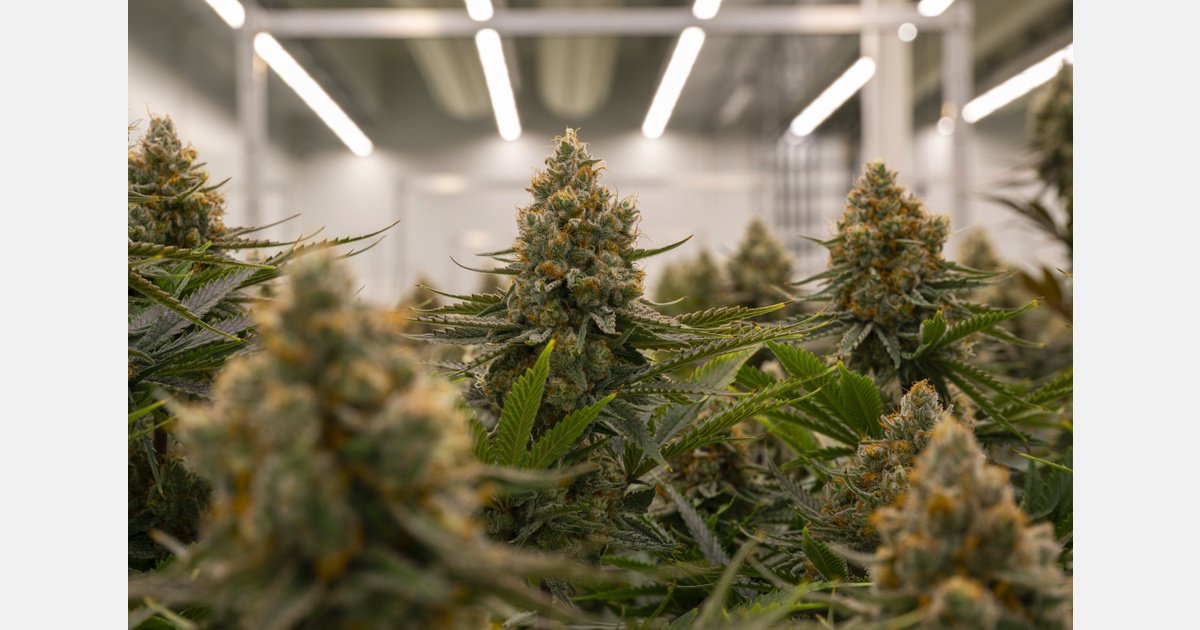
Village Farms reported a 500%-plus rise in cannabis exports by the end of 2025 as international sales climbed to US$37.9 million, roughly 20% of the company’s total cannabis revenue of about US$188 million. The company, which operates one of the world’s largest cannabis facilities in Delta, B.C., named Germany, Australia, the United Kingdom, New Zealand and Israel among its main export markets.
Village Farms is expanding capacity to meet that demand. The company is developing an additional 550,000 square feet of greenhouse space across the street from its primary site to support both domestic and export cultivation. Orville Bovenschen, Village Farms International’s global president of operations, said excise taxes remain a heavy cost for growers: “If you see how much we paid in excise tax last year, it’s astronomical,” he told industry observers, though the company did not disclose exact tax payments.
Canada’s federal excise tax system levies duties by weight rather than by price. As wholesale cannabis prices fell to roughly half of initial projections, the fixed-weight duty has translated into higher effective tax rates on producers. That shift has pushed several British Columbia growers to prioritize overseas sales.
Sweetgrass Cannabis, a micro-cultivator in the Kootenay region, now earns 60–70% of its revenue from international markets after retreating from larger Canadian provinces such as Ontario and Alberta. Chief operating officer Gemma Hayes cited margins and the combined cost of provincial wholesale markups and federal excise duties as drivers of the move. Ontario’s wholesale markups can add as much as 25% on top of excise taxes, which Sweetgrass said compressed prices into what Hayes called a “race to the bottom.”
Rubicon Organics, a Vancouver-listed company, began exporting last year and opened a 47,500-square-foot facility in Hope to fill overseas orders. Mathieu Aubin, Rubicon’s vice-president of marketing and new business, spoke from the International Cannabis Business Conference in Berlin and highlighted Canada’s reputation for consistent, safety-focused production as an asset in medical markets that demand product traceability and regulatory compliance.
Smaller and outdoor producers face barriers that curb export opportunities. Alex Rumi, co-founder of Good Buds on Salt Spring Island, said existing export channels favor indoor, pharmaceutical-style production and place sun-grown cannabis at a commercial disadvantage. He added that the administrative and logistical model for exports—where producers must secure permits for every shipment and meet different country-specific requirements—raises fixed costs that small operators struggle to absorb.
Julia Cameron, president of the Cannabis Cultivators of B.C. and vice-president of communications and corporate affairs at Village Farms International, noted that cross-border paperwork and heterogeneous import standards create friction. That friction increases per-shipment costs and forces many small producers to stick to local or provincial markets.
British Columbia houses more than 200 licensed cannabis producers and produces about 25% of Canada’s legal cannabis by volume. Despite that output share, the province accounted for approximately 14% of national exports in the latest reporting period. The gap illustrates how export access is concentrated among producers with larger indoor capacity, export-grade processing, and resources to manage international compliance.
Industry leaders see near-term demand opportunities. B.C. Minister of Agriculture and Food Lana Popham pointed to upcoming FIFA World Cup matches in Vancouver as a potential window for international visitors to sample B.C. cannabis, noting the province’s reputation for product quality.
The export pivot reflects specific economic pressures: falling domestic wholesale prices, a weight-based excise tax that does not fall with prices, and provincial distribution markups that raise retail and wholesale costs. Producers that scale up controlled-environment cultivation and processing report better access to markets that require pharmaceutical-style standards. Micro- and sun-grown operators report lost market share unless regulators or market structures change to reduce per-shipment administrative burdens and adapt tax treatment to market prices.
Policy choices will shape how many B.C. producers can expand exports. For now, larger firms with export infrastructure and capital are converting lower domestic margins into revenue by selling abroad, while smaller growers often shift sales to overseas customers only after exiting high-cost domestic channels.
Data points from the sector: – Village Farms International: international cannabis sales US$37.9 million; total cannabis revenue ~US$188 million; export volumes rose more than 500% by end of 2025. – Expansion: 550,000 additional square feet of greenhouse under development at Village Farms. – Rubicon Organics: new 47,500-square-foot facility in Hope to serve export demand. – Sweetgrass Cannabis: 60–70% of sales now from international markets after pulling back from Ontario and Alberta. – Provincial footprint: B.C. has over 200 licensed producers, ~25% of Canada’s legal cannabis output, ~14% of national exports.
Those figures show which producers scale to export markets and which face barriers because of production method, regulatory cost, and tax structure. Export growth offers measured revenue gains for companies that can meet foreign regulatory standards and absorb per-shipment costs; smaller operators report narrower options without policy changes to excise rules or export permit administration.


