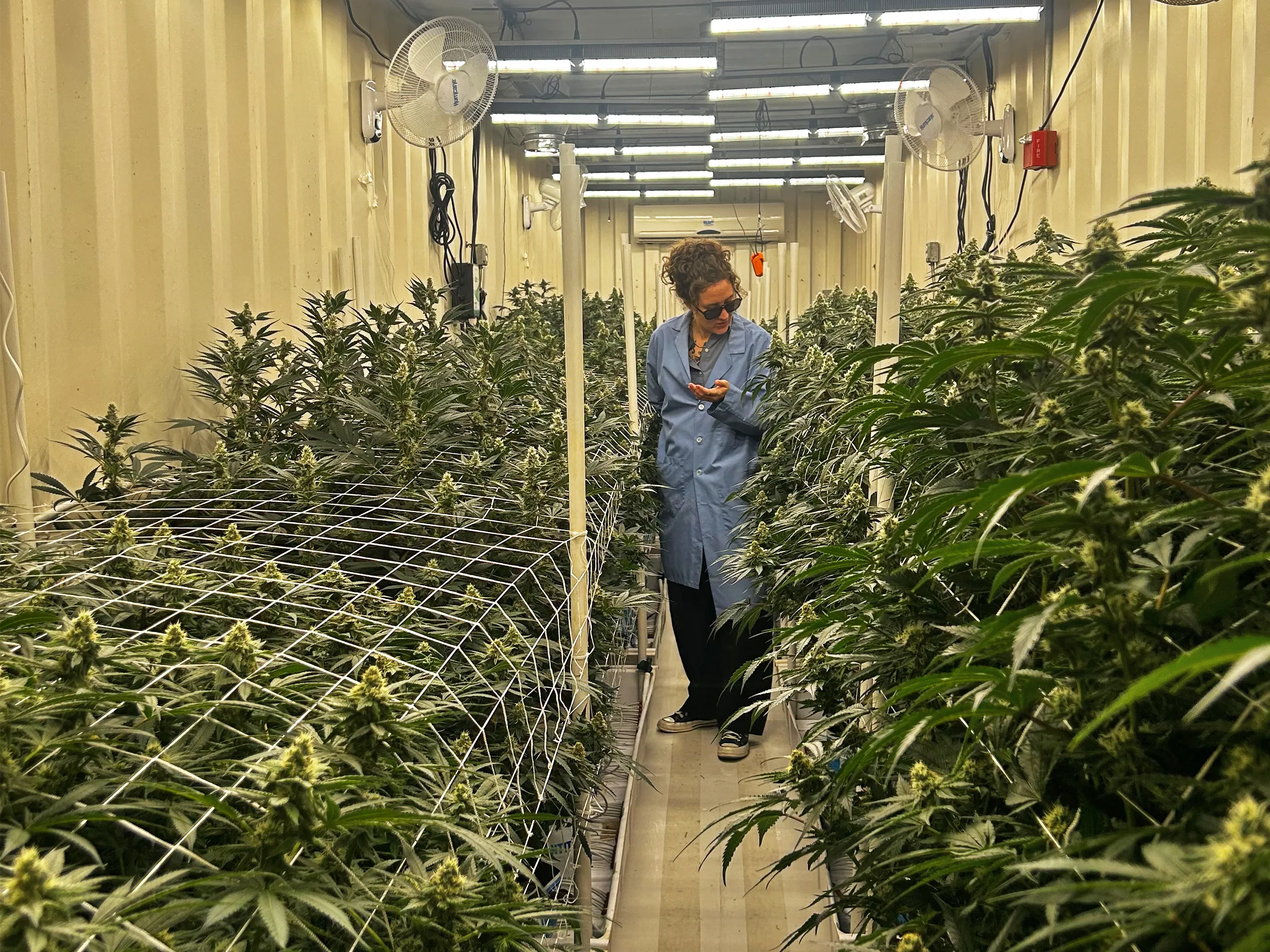
medical cannabis patients in Texas receive products made at licensed sites such as Texas Goodblend. I toured Goodblend’s secure production campus — a roughly 250-by-250-foot site the company calls “the ranch” — and observed growing, extraction, testing, manufacturing, and distribution carried out inside repurposed shipping containers.
Security and compliance
Goodblend’s office monitors production with 30–40 cameras and follows rules set by the Texas Department of Public Safety. Staff compare those rules to high-stakes regulation: access controls, continuous video, and restricted addresses limit who can see the operation. Company managers declined to give the exact address and keep plant genetics confidential.
Mothers and propagation
The first container houses the mother plants. Goodblend keeps only female mother plants to prevent seeding; male plants and pollination would cause hermaphroditism and ruinable crops. The mothers receive reverse-osmosis water and a high-light vegetative schedule: 18 hours of light per day for three weeks. Technicians propagate clones from those mothers so each crop is genetically identical. Once growers reduce light to 12 hours daily, the plants shift into flowering.
Vegetation, CO2 and strains
A separate container holds plants transitioning from vegetation; another contains flowering plants. Grow team lead Richard Ritz described seven active strains grown on-site (company proprietary). Goodblend injects carbon dioxide into the flowering container to raise CO2 levels above ambient; employees reported it increases plant growth and affects staff alertness. Staff also monitor humidity, temperature, and nutrient delivery to reduce mold and pest risk.
Extraction and oil production
Technicians cut flower and use ice-cold ethanol to extract cannabinoids and terpenes. Goodblend’s extraction process places plant material in mesh bags, agitates them in a machine similar to a washing drum, then removes ethanol by heating the extract in a vacuum-assisted flask to ethanol’s boiling point. The published timeframe for that removal is about 10 hours per batch. After ethanol removal, staff decarboxylate the extract—applying controlled heat to convert THCA to active THC—producing a concentrated cannabis oil suitable for edibles, tinctures, and vaporizers.
Testing and quality control
Analytical processing manager Adam Richardson runs full-panel testing at multiple stages. He checks genetics and potency, measures cannabinoid profiles, and screens for residual solvents and contaminants. Richardson noted that the wider hemp and THC product market has inconsistent labelling and variable results; he said in-house testing reduces the risk of mislabeled potency or solvent carryover. He emphasized solvent testing because cannabis extracts can retain processing chemicals if not fully purged. Goodblend’s protocol includes checking finished oil prior to manufacturing and validating batches before distribution.
Manufacturing and packaged products
Production and manufacturing manager Emily Greene described the on-site kitchen where staff handcraft edibles using a pour-and-scrape method. They make two types of gummies: gelatin-based and pectin-based (vegan). The chocolate line cools on a conveyor belt that uses a window AC unit to maintain tempering temperatures. The facility also packages tinctures, topicals, beverages, and, more recently, vaporizers. Staff label each product with measured milligram THC values drawn from lab results.
Distribution channels and logistics
Distribution manager Alex Alvarado oversees three distribution pathways: company storefronts, home delivery, and coordinated pick-up through partnering physicians. For the physician pathway, Goodblend holds product for a four-hour pick-up window tied to a doctor’s prescription schedule. Alvarado identified inventory accuracy, secure transport, and time-limited pick-ups as operational bottlenecks that affect patient access to products under the Texas Compassionate Use Program (TCUP).
Why licensed production matters
Goodblend’s controls illustrate differences between licensed medical supply and many commercial hemp products. The company documents growth cycles, tracks strain genetics, runs solvent screens, and measures potency with instrumented testing. For patients with PTSD, cancer, or chronic pain who need consistent dosing, those measures reduce variability. In contrast, Richardson noted, some commercial products on the market can show degraded THC or incorrect labels when companies do not test through the same set of checkpoints.
Staff and process notes
– Cameras: 30–40 monitoring units cover production. – Site size: roughly 250 by 250 feet. – Mother vegetative phase: 18 hours of light for three weeks. – Flowering trigger: drop to 12 hours of light per day. – Strains: seven proprietary varieties grown on-site. – Extraction cycle: ethanol wash and a roughly 10-hour solvent removal. – Delivery methods: storefront, home delivery, and physician-coordinated pick-up within a four-hour window.
Goodblend employees use specific roles to hold product quality: cultivation leads run lighting and CO2; extraction technicians manage solvent purge and decarboxylation; analytical staff run potency and solvent assays; production managers handcraft edibles; and distribution staff track inventory and delivery logistics.
Limits and patient access
Even with tight controls, Goodblend’s managers described distribution as a key barrier for patients. Texas’s medical cannabis law limits which providers can prescribe and requires specific delivery or pick-up methods. That regulatory framework and the logistics of small-batch, tested manufacturing create friction for patients who need steady access.
What a patient can expect
Patients who use TCUP-licensed products can expect batch-specific potency labels, testing for residual solvents, and packaging that lists milligrams of THC. Goodblend also offers different formats—gummies (gelatin and pectin), tinctures, topicals, beverages, and vaporizers—so a clinician can match dosing form to a patient’s needs. The company’s emphasis on in-house testing and closed production chains reduces some of the variability seen in off-market hemp products.
The ranch model
Operating inside shipping containers gives Goodblend discrete, modular spaces for each step: mother plants, vegetation, flowering, extraction, testing, cooking, and distribution. That layout isolates contamination risk and streamlines regulatory inspections. Still, managers said they remain cautious about public details: they keep strain identities and some operational specifics private to protect intellectual property and patient safety.
Bottom line
Texas Goodblend runs a tightly controlled, containerized production pipeline focused on measured potency and solvent-free extracts. The company tracks specific metrics—light schedules, CO2 levels, extraction times, and lab results—to deliver consistent products for medical cannabis patients in Texas. Distribution constraints tied to state rules and small-batch logistics continue to influence patient access and company operations.