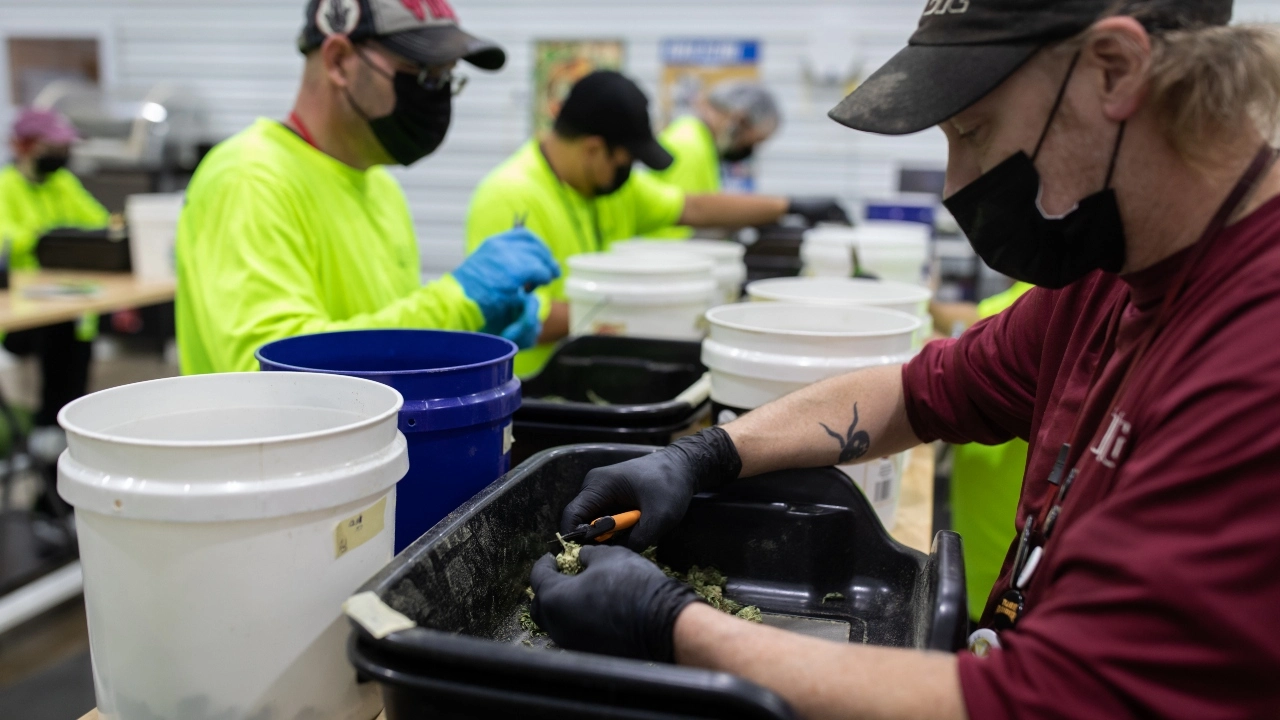

california cannabis manufacturers CannaCraft and NorCal (GB2 LLC) are cutting 109 jobs as demand and scale pressures squeeze operations in the state’s largest legal market. The reductions, filed in federal WARN notices, affect production, packaging and trimming staff at two Santa Rosa facilities.
CraftForce Services, the manufacturing arm of CannaCraft, will lay off nearly 60 employees at its Santa Rosa site effective Sept. 20, according to a WARN notice. NorCal Cannabis Co., operating as GB2 LLC, will lay off about 49 workers on Sept. 13, the company reported in a separate WARN notice first published by The Santa Rosa Press Democrat.
Bret Peace, CEO of parent company Groundwork Holding, attributed the CannaCraft cuts to industry consolidation and a mismatch between facility scale and current market demand. “It’s not a decision we made lightly,” Peace told The Press Democrat. He said manufacturers now require fewer, more specialized staff and less physical space, and that CannaCraft’s previous scale “didn’t materialize.” CannaCraft merged with Southern California retailer March and Ash in 2022.
Most affected CannaCraft employees are production technicians; many are represented by United Food and Commercial Workers (UFCW) Local 5. NorCal’s impacted workers largely perform packaging and trimming and, the newspaper reported, are not unionized.
Market context: licensed California cannabis retailers reported $3.9 billion in sales in 2025, down from $4.2 billion in 2024 and $4.4 billion in 2023, according to state data from the California Department of Tax and Fee Administration. That marks three consecutive years of declining legal sales in the country’s largest adult-use market.
Local responses and fiscal moves: Sonoma County’s Board of Supervisors approved a targeted tax change in April that reduces the cannabis business tax rate to $0 for qualifying operators in fiscal 2026-27. The board also created an annual licensing program with fees starting above $500 to fund county commercial cannabis oversight. The county action aims to lower costs for some operators while establishing a recurring revenue stream for regulation.
Industry-wide job trends: The U.S. legal cannabis industry employed 412,500 people in early 2026, a 2.7% drop from 425,002 reported the prior year, according to the U.S. Cannabis Jobs Report 2026 from staffing platform Vangst and research firm Whitney Economics. Other firms have cut production roles: multistate operator The Cannabist Co. recently closed cultivation operations in Colorado and New Jersey.
Cause and effect: Companies cited two main drivers for the layoffs — a shrinking legal market and a shift toward smaller, more efficient manufacturing footprints. CannaCraft’s statement and its CEO’s remarks point to competition from operators with leaner facilities and specialized labor that lower per-unit production costs. When sales decline by hundreds of millions statewide, wholesale margins tighten, and manufacturers with larger overhead face acute pressure to reduce labor and move to smaller operations.
Worker impact and union representation: At CannaCraft, many of the production technicians are union members, which may affect severance, recall rights, or bargaining over cuts. At NorCal, most impacted employees are non-union packaging and trimming workers; their transitions depend on company policies and any local workforce programs. WARN notices provide minimum advance notice but do not guarantee rehiring or specific severance terms.
What this means for the market: Falling retail sales — from $4.4 billion in 2023 to $3.9 billion in 2025 — reduce demand for flower, extracts and packaged goods, which in turn lowers orders for manufacturers. Companies that expanded capacity in anticipation of faster market growth now face excess space and labor costs. Some operators respond by consolidating facilities, cutting staff, or exiting cultivation and manufacturing entirely.
Outlook: Market contraction and cost pressure are likely to prompt more restructuring across California manufacturing and distribution in 2026. Local policies such as Sonoma County’s tax adjustment can affect operator margins, but analysts say sustained recovery would require stable or growing retail demand, tighter control of unlicensed supply, or new product streams that increase per-customer spending.
Sources and documentation: The layoffs were reported in federally required WARN notices and first noted by The Santa Rosa Press Democrat. State retail sales figures come from the California Department of Tax and Fee Administration. Employment trends cite the U.S. Cannabis Jobs Report 2026 (Vangst and Whitney Economics).