
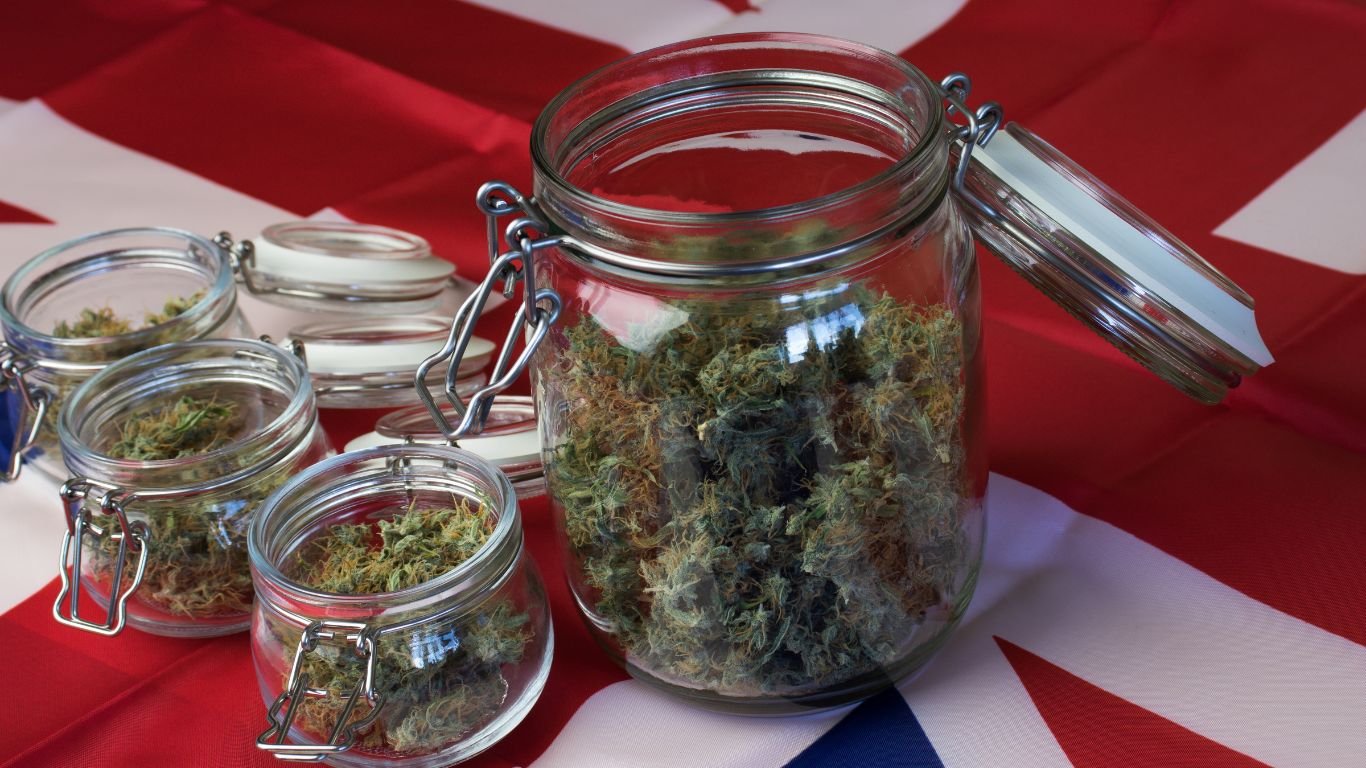
A new Prohibition Partners report finds that medical cannabis from Canada accounted for about 70–80% of the United Kingdom’s total medical cannabis supply in 2025. Canadian exports to the UK rose 562% year-over-year between 2024 and 2025, reaching 17.07 tonnes (17,070 kg), and Canada represented roughly 96% of the UK’s annual import growth for 2025, according to data drawn from a UK Home Office FOI request and Prohibition Partners’ market platforms.
Market share and trade flows Prohibition Partners reports that the UK imported 30,062 kg of medical cannabis in 2025. Of that total, 17,068 kg arrived directly from Canada (57%). Additional imports routed through Portugal and Germany—countries that also source substantial volumes from Canadian producers—accounted for another 5,375 kg combined. Based on those flows, the report estimates Canada supplied roughly 70–80% of the UK’s medical cannabis supply in 2025.
The shift toward Canadian supply displaced other exporters. Spain’s share of the UK market fell from 51% in 2023 to 11.4% in 2025. Prohibition Partners concludes that competing on volume alone against Canadian exporters has become increasingly difficult for other supplier countries.
Domestic production and prescription channels Domestic cultivation supplied about 14% of the UK’s total medical cannabis in 2025, produced by companies such as Glass Pharms, Dalgety, and Celado. Most patient access occurs through private-pay teleclinics: more than 40 telemedicine providers operate nationwide, but the top eight platforms account for roughly 80% of prescriptions.
Product mix and pricing Dried flower comprised about 80% of the UK medical cannabis market by volume in 2025. Extracts made up roughly 15%, and vapes about 5%. Vape product availability expanded: the number of vape SKUs rose from 20 in May 2025 to 44 in March 2026. Canada was the primary source for dried flower SKUs in 2025, while the UK supplied the largest share of vape and extract SKUs. Canadian companies such as Aurora and AgMedica appeared among vape providers that year.
Price data show dried flower trading near £5.50–£7.00 per gram (~C$10–13 per gram) in March 2026. Vape prices per milligram of cannabinoid content fell 25% between May 2025 and March 2026, from 11.9 pence/mg to 8.9 pence/mg (about C$0.17–0.22 per mg). Using the lower conversion, an 800 mg THC one-gram cart priced at C$0.17 per mg implies C$136 CAD; by contrast, retail listings on OCS.ca showed typical 1-gram high-THC vape carts priced between C$30 and C$45 CAD, illustrating gaps between export-unit pricing calculations and domestic retail prices.
Company export performance and capacity Several large Canadian licensed producers increased export volumes and revenue to meet global demand. Aurora Cannabis reported international medical cannabis net revenue of $112.1 million for the year ended March 31, 2026, out of $320.6 million in total net revenue. Village Farms disclosed $14.6 million in exports in the first quarter of 2026 within nearly $50 million in cannabis sales and has begun planting the first half of a greenhouse expansion that the company says will add about 40 metric tonnes of annualized production—roughly a 33% increase in Canadian capacity when complete in 2027. Tilray reported $28.3 million in export sales for the three months ended November 30, 2025, a 36% year-over-year increase in international cannabis sales versus a 6% rise in the Canadian adult-use market.
Tax and policy drivers Export demand draws Canadian producers in part because exports avoid Canada’s domestic cannabis excise tax of $1 per gram. Higher export prices in many markets and the absence of that excise levy have improved exporter margins. The Canadian industry has pushed federal and provincial governments to recognize cannabis’ contribution to national exports; the sector contributed nearly $11.6 billion to Canada’s 2025 GDP, per the report.
Implications for suppliers and buyers The UK’s reliance on Canadian supply reflects Canadian producers’ longer experience with large-scale logistics, regulatory compliance, and international distribution. That experience, combined with recent capacity expansions and favorable export economics, has allowed Canadian firms to scale shipments rapidly. For competitors in Spain, Portugal, Germany and elsewhere, the report suggests that competing on volume and price alone will be difficult without investments in scale, consistent quality, and supply-chain reliability.
Methodology note Prohibition Partners based its findings on UK Home Office FOI data and its internal market-tracking platforms. The report separates direct imports from third-country routing (for example, Canadian-origin product re-exported via EU countries), which explains differences between direct-import totals and broader supply estimates.
Bottom line In 2025 Canadian producers supplied the majority of the UK’s medical cannabis market by volume. Rapid export growth, expanding vape and extract SKUs, falling vape-unit prices, and planned Canadian production increases suggest that Canada will remain a dominant supplier to the UK in the near term unless UK domestic production or alternative suppliers scale quickly.